Early Christian Rome
Exploring the Intersection of the Ancient World & Early Christianity
Early Christian Rome
Exploring the Intersection of the Ancient World & Early Christianity
Welcome to a resource for those wanting to create customized itineraries to Rome, particularly those that focus on the intersection of ancient Rome and early Christianity. More and more pastoral leaders and educators have grown to appreciate Rome as a powerful venue for bringing to life the people, places, and events of earliest Christianity.
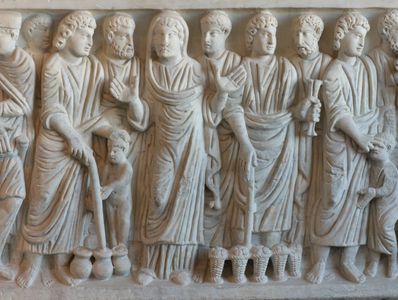
Rome offers more early Christian sites and artifacts than any place in the world. The city features early house churches, basilicas, catacombs, frescoes, mosaics, and decorated sarcophagi - many from the earliest centuries of the church. Visitors gain an appreciation for the context of the first generation of Christians as these venues coexist with the great monuments of ancient Rome. What was it about Christianity that captured the religious imagination of Rome? How did Christianity distinguish itself from other mystery religions? How did Christianity influence the Roman Empire and how did the Empire shape Christian beliefs, practices, and institutions? It is the place where St Paul's vision of a universal (non-sectarian) monotheism found both its antithesis and fertile ground for evangelization. It is the place where the evangelists could compare and contrast the Pax Romana with the Pax Christi. Rome continues to challenge contemporary Christians to ponder their mission in a world not that dissimilar from ancient as well as Renaissance Rome.


By special request, visits are possible to excavations under St. Peter's Basilica of a Roman cemetery that existed adjacent to an arena where St. Peter and early Christians were martyred after the fire of Rome in 64 CE. The site is amazing and helps show why Emperor Constantine chose to build a monumental basilica here, celebrating the witness and authority of St. Peter. Visitors have a chance to see pagan and early Christian funerary art and symbols.
A walking tour of the Roman Forum allows visitors to imagine life in ancient Rome and ponder the context of the rise of Christianity. There are several medieval Christian sites built inside of ancient Roman buildings. It is the perfect place to compare and contrast Christian beliefs and practices with Roman ones - underscoring some commonalities and some differences.
The Basilica of San Clemente is a stone's throw away from the Forum and Colosseum. It was built on top of 1st century Roman buildings and a Mithraeum. Later, a medieval church was built on top of the earlier structure. At this one site, the entire history of Christianity at Rome can be explored. It is a great venue to compare and contrast Mithraism and Christianity.
With its magnificent mosaic apse, it is a wonderful locale to identity Christian symbols and art.
The Pio-Christian section of the Vatican Museum houses one of the greatest collections of early Christian art in the world. Elaborately decorated marble sarcophagi depict biblical scenes. It illustrates the stories and images that captured the imagination of 3rd, 4th, and 5th century Christians during the transition from classical Roman religion to Christianity.
The Catacombs have always been a draw for visitors to Rome. They showcase the population of Roman Christianity over several centuries. Frescos underscore primitive Christian imagery and the beliefs that inspired them.
This monumental basilica was built over St. Paul's tomb. In the 1800s, there was a massive fire, requiring a rebuild of the structure. It was reconstructed according to the original plans of the 4th century, resulting in one of the most pristine examples of monumental Roman structures in the city.
The Altar of Peace, dedicated to Augustus, is a great site for comparing and contrasting early Christianity and the Roman Empire.
The Evangelists, particularly Luke, underscored the genuine peace that Jesus offered to humankind, challenging the Imperial Roman narrative.
On the side of the building showcasing the Ara Pacis is a copy of the Res Gestae Divi Augusti - the great deeds of the divine Augustus. Again, the Gospels were written to counter this.
The site offers a great place to set the context for early Christian writings.

An accessible and compelling book is Rodney Stark's "The Rise of Christianity." It sets the context of the first generation of Christians and why they were inspiring to their pagan counterparts.
A great overview of Roman churches and religious structures is Matilda Webb's book, "The Churches and Catacombs of Rome: A Comprehensive Guide.
More books to follow.
Pedestrian Rome - Rome has increasingly become a pedestrian city. Large tour buses are prohibited from the city center. Access to many religious sites require either special vans or walking. It is advisable to select hotels in the historical center for easier access. Contact us for suggestions.
Rome is blessed with countless restaurants. Some of our favorites include:
Archimede Sant'Eustachio, Da Polese, Abruzzi (near Piazza dei Santi Apostoli), Da Roberto's in the Borgo Pio, and Cecilia Metella (on the Via Appia Antica). More suggestions to follow.